

Imagine standing at the edge of the world, the ocean stretching endlessly before you. A great bird glides silently above the waves, wings outstretched, never flapping, dancing on the wind with an elegance that seems to defy physics.
You’re watching an albatross.
These majestic seabirds are renowned not only for their size and global journeys, but also for a unique, almost mystical way of flying known as dynamic soaring. Unlike hawks or vultures that rely on rising warm air in a motion called static soaring, albatrosses use something much more subtle, and much more powerful.
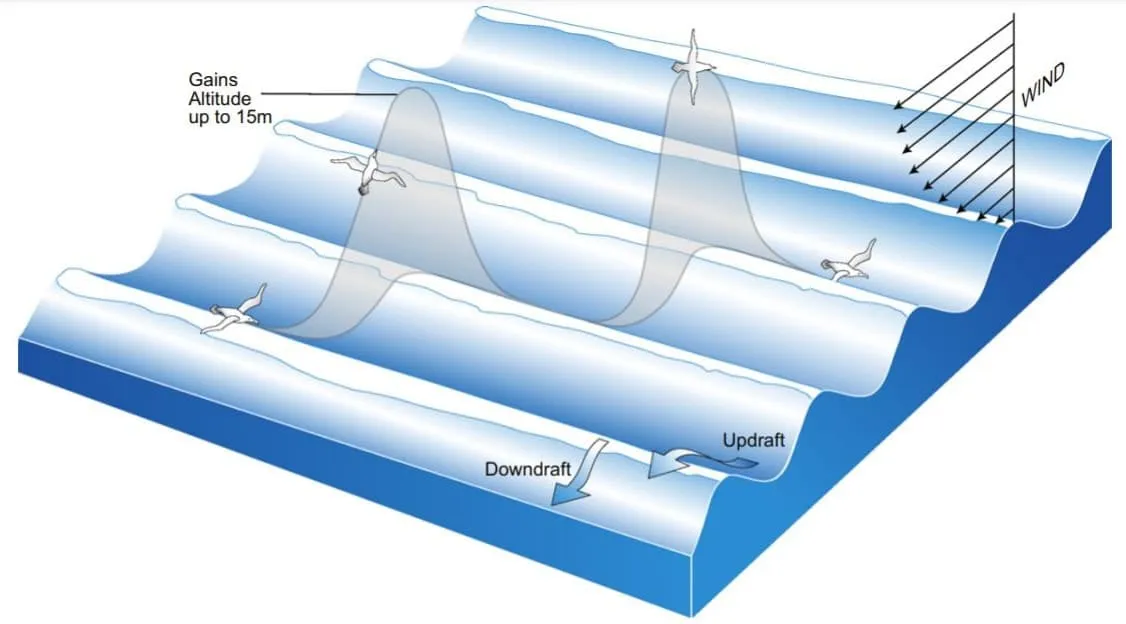
Dynamic Soaring: Nature’s Wind Engineers
Over the ocean, wind moves differently. The air closest to the surface is slower due to friction, while higher layers move faster. Centuries ago, sailors knew this well, it’s why tall ships were built with towering masts to catch stronger winds above.
Albatrosses exploit this vertical wind gradient masterfully. They rise into the faster-moving air, then swoop back down toward the surface in a graceful loop, gaining and releasing energy with each maneuver. This cycle, windward climb, leeward turn, downwind descent, and a swift glide near the waves—requires almost no flapping at all.
For years, this flight pattern was just a theory. But recent breakthroughs in GPS tracking changed everything.
Engineering Meets Ornithology
To truly understand the mechanics of this energy-efficient motion, aerospace engineers joined forces with scientists. Using cutting-edge GPS devices capable of tracking centimeter-level changes at incredibly high frequency, researchers tagged 16 wandering albatrosses to analyze their every move.
What they found was astonishing: the birds’ real-world flight perfectly matched the theoretical model. They weren’t gaining energy from wave turbulence or atmospheric pressure shifts. It was all about the wind, and their ability to ride it with precision.
A Masterclass in Motion
Each albatross flight cycle is a masterclass in physics: climbing upwind builds potential energy, a downward swoop converts it to speed, and a low sweep just above the waves prepares them for the next climb. This continuous loop allows them to travel thousands of kilometers across the Southern Ocean with barely a flap.
The Magic Up Close
If you’re lucky enough to visit places like West Point Island, you might see this phenomenon with your own eyes. Watching these giant birds crash-land clumsily into their nests,after such elegant flight,is a sight both humbling and heartwarming.
Welcome to the kingdom of albatrosses – West Point, Falklands/Malvinas.
These seabirds spend 90% of their lives at sea, fly thousands of kilometers without landing, and some even mate for life. Watch them master the wind like no other.